
Is 'You Can't Bulk on Keto' True? Can You Actually Build Muscle Without Carbohydrates?
Published:
Written by: Shingo YoshizakiReviewed by: Tomonobu Someda
Competing claims surround keto and bulking: 'ketogenic bulking is inefficient,' 'you can't build muscle without insulin,' and yet many practitioners report building muscle on keto. This article uses research data to separate fact from misconception.
Let the data settle it.
You absolutely cannot build muscle on a ketogenic diet
What's said
ボディビルフォーラム・増量期は「高炭水化物が絶対」という通説
'Without carbs you're catabolic — you're just breaking down muscle. Keto bulking simply doesn't happen.'
What research says
- This claim is exaggerated.
- Research including ketogenic-diet-body-composition-rct confirms that lean mass gains occur on ketogenic diets when caloric surplus and adequate protein (1.6–2.2 g/kg bodyweight) are maintained.
- Protein-intake-muscle-meta shows that the primary drivers of muscle protein synthesis are protein intake and resistance training — not insulin per se.
- Both conditions are achievable on keto.
- However, high-protein-overfeeding-rct suggests that matching hypertrophy rates seen in high-carbohydrate diets under identical calorie and protein conditions can be difficult. 'Can't build muscle' is false, but 'less efficient' has some support.
Building muscle on keto is possible — 'absolutely can't' is an exaggeration. Under matched conditions, however, achieving hypertrophy at the same rate as high-carbohydrate diets can be difficult. Keto is not ideal for maximizing hypertrophy, but 'no muscle gain whatsoever on keto' is incorrect.
Keto bulking only adds fat, not muscle
What's said
「脂肪→脂肪蓄積が直線的」というカロリーパーティション論
'On keto, a caloric surplus just adds fat — the high-fat environment makes fat storage highly efficient while muscle gain stays negligible.'
What research says
- High-protein-overfeeding-rct demonstrates that even at matched caloric surplus, high protein intake groups show significantly less fat gain and more lean mass gain — protein quantity, not calorie source, is the primary determinant of body composition outcomes.
- Keto bulking with high protein is theoretically capable of minimizing fat gain while increasing lean mass.
- Practically, however, keto's high dietary fat content makes it easy to oversupply fat calories, and failing to deliberately prioritize protein intake risks producing a fat-heavy bulk.
The claim that 'keto bulking only adds fat' is oversimplified. Adequate protein (2+ g/kg bodyweight) enables body composition-controlled bulking on keto. The practical pitfall is that protein intake often runs low on keto due to the diet's high fat emphasis.
Ketogenic bulking is the optimal lean bulk strategy
What's said
ケトジェニック推進コミュニティの増量戦略論
'Keto bulking is the ultimate lean bulk: insulin stays low so fat storage is minimal while muscle grows cleanly.'
What research says
- The claim that 'low insulin means minimal fat gain' is oversimplified.
- Fat storage is determined by total energy balance (intake > expenditure), not insulin alone — fatty acids themselves are incorporated into adipocytes via insulin-independent pathways (e.g., acylation-stimulating protein).
- Carbohydrate-periodization-meta shows that low-carbohydrate groups do not consistently show less fat gain than high-carbohydrate groups during a bulk.
- Caloric surplus management remains the primary variable.
- Additionally, the high-intensity training limitations on keto can reduce training volume and thereby diminish hypertrophic stimulus — a meaningful risk for the keto bulk approach.
The claim that 'keto is optimal for a lean bulk' is an overstatement. Low insulin doesn't automatically prevent fat accumulation — energy balance dominates. High-intensity training limitations also risk reducing hypertrophic stimulus. There is currently insufficient evidence that keto lean-bulking offers an advantage over carbohydrate-inclusive approaches.
Related supplements
PR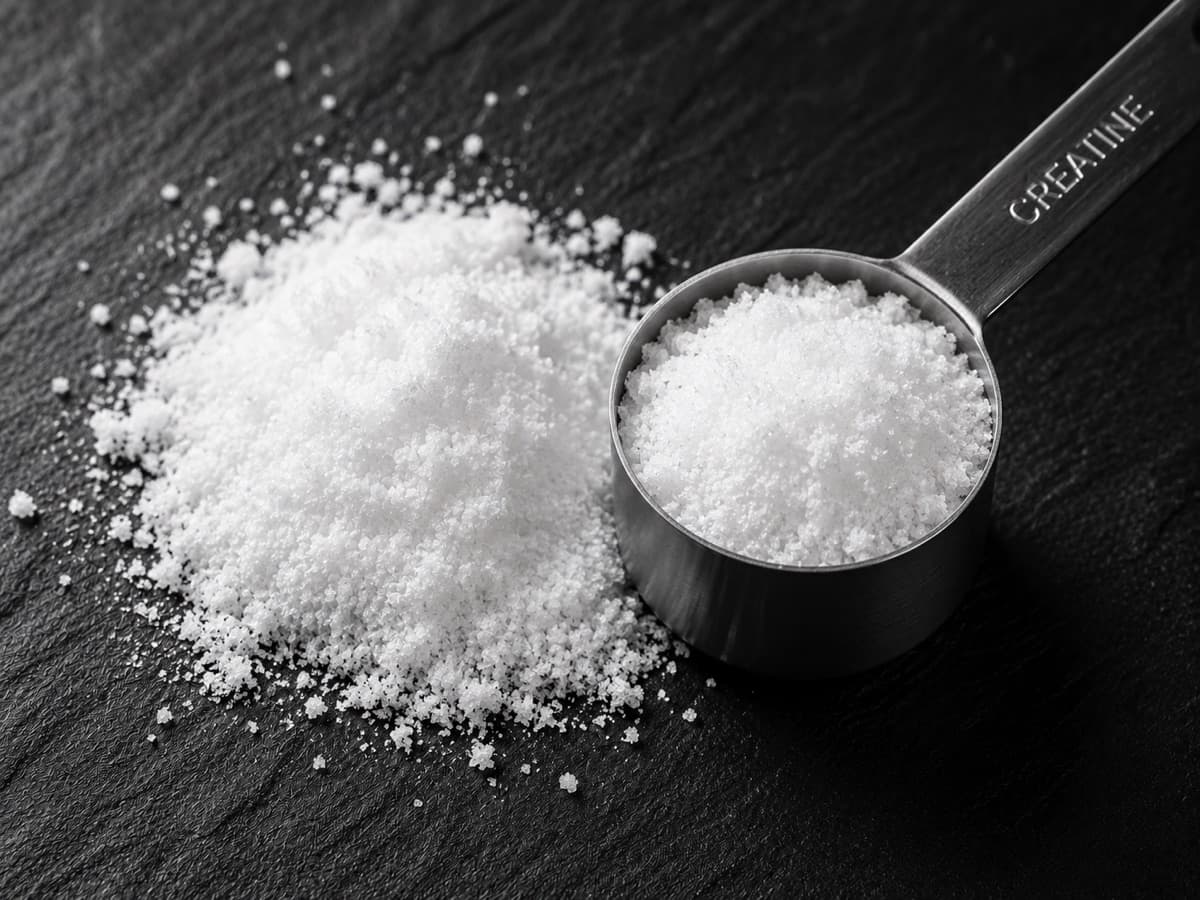 CreatineView in official store
Improved high-intensity, repeated-effort performance
 MCT Oil (Medium-Chain Triglycerides)View in official store
More rapid absorption and conversion to ketone bodies compared with long-chain fats, potentially supporting fast-acting energy availability
 ElectrolytesView in official store
Reported to maintain performance better than water alone in exercise over 60 minutes
The links below include affiliate links (PR).
Related research
- Efficacy of ketogenic diet on body composition during resistance training in trained men: a randomized controlled trial2018
- Protein supplementation augments resistance-training-induced gains in muscle mass and strength (meta-analysis)2018
- High-Protein Overfeeding and Body Composition in Trained Individuals: An 8-Week RCT2014
- Carbohydrate periodization and its effects on training adaptation and body composition: a systematic review2011
- Dose-response relationship between weekly sets (training volume) and hypertrophy (systematic review)2017
Sources
Published:
Written by
Shingo YoshizakiSoftware Engineer / Research Writer at BODYDATA
An engineer's job is verification. I read the source before I trust gym lore — same as code.
View profile →
Reviewed by: Tomonobu Someda
Content reviewed from the perspective of coaching practice and supplement-industry experience
Read next
- Research vs Bro-science
Is 'Keto Is Bad for Lifting' True? What Research Says About Strength and Power on Ketogenic Diets
You often hear that 'keto is bad for lifting' or 'you lose explosive power on low-carb.' At the same time, others claim performance is fully maintainable on ketogenic diets. This article examines both claims against the research and clarifies what actually happens.
Shingo Yoshizaki
- Research vs Bro-science
Keto vs. Carb Cycling: Which Is Better for Fat Loss and Muscle Preservation?
'Keto or carb cycling?' is one of the most common diet strategy questions in body composition management. Keto claims 'constant fat burning'; carb cycling claims 'strategic carbohydrate use protects muscle.' This article uses research to compare their actual performance.
Shingo Yoshizaki
- Explainer
How Long Does Keto Adaptation Take? The Process of Becoming Fat-Adapted
Keto adaptation follows a staged process: basic adaptation (keto flu resolution, stable energy) completes within 2–4 weeks; maximum fat oxidation capacity and exercise performance optimization takes 4–12 weeks. Entering ketosis (blood ketones ≥ 0.5 mmol/L) occurs within 2–3 days of carbohydrate restriction — but ketosis entry and 'full keto adaptation' are not the same thing. Signs of advancing adaptation include stable energy levels, recovering exercise performance, reduced hunger, and stabilizing ketone test strip readings.
Shingo Yoshizaki