
Muscle Creatine Loading in Men: High-Dose 6-Day vs Low-Dose 28-Day Regimens
Hultman E, Söderlund K, Timmons JA, Cederblad G, Greenhaff PL
Evidence is still building up
Summary
A foundational mechanistic study in 31 healthy men examining, via muscle biopsy, how different creatine intake protocols affect muscle total creatine concentration. There is no mention of randomization or a placebo control; it compares rapid loading (20 g/day for 6 days, then 2 g/day for 30 days as maintenance) against a no-loading protocol of 3 g/day for 28 days. Both protocols increased muscle total creatine concentration by a similar amount (approximately 20%), reaching the same final level. Continuing at 2 g/day after loading maintained the elevated concentration, but it returned to baseline within 30 days of stopping supplementation.
Key findings
- 1
Rapid loading at 20 g/day for 6 days increased muscle total creatine concentration by approximately 20%
- 2
A no-loading protocol of 3 g/day for 28 days reached a similar ~20% increase, with no significant difference in final concentration
- 3
Continuing at 2 g/day after loading maintained the elevated concentration, but it returned to pre-supplementation levels within 30 days of cessation
- 4
No randomization or placebo control is described; this is a mechanistic study comparing muscle-biopsy outcomes across intake protocols
- 5
Conducted in 31 healthy men; caution is warranted extrapolating to women, older adults, or different training states
Related supplements
PR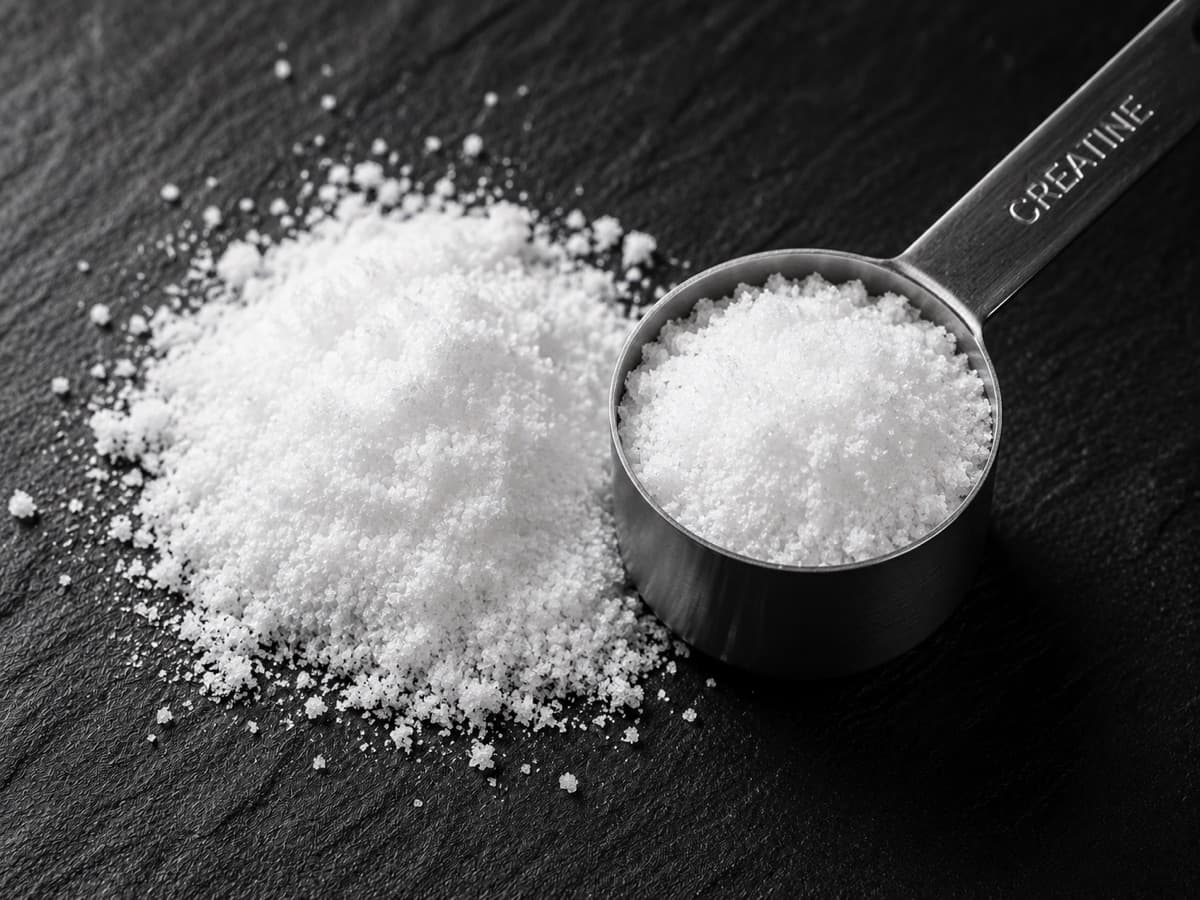 CreatineView in official store
Improved high-intensity, repeated-effort performance
The links below include affiliate links (PR).
Related research
Creatine supplementation augments gains in strength and lean mass from resistance training (meta-analysis)
Open Access Journal of Sports Medicine, 2017
A pooled analysis of RCTs in older adults. Adding creatine to resistance training produced significantly greater gains in lean mass and upper/lower-body strength than placebo.
Comparison of creatine monohydrate with other forms (ethyl ester, HCl, buffered, etc.): a systematic review
Amino Acids, 2011
A review comparing creatine monohydrate with alternative forms (creatine ethyl ester, HCl, buffered creatine=Kre-Alkalyn, micronized, etc.) for efficacy, safety, and cost-effectiveness. Creatine monohydrate has the strongest evidence base; no alternative form has demonstrated superiority.
ISSN Position Stand: Safety and Efficacy of Creatine Supplementation in Exercise, Sport, and Medicine
Journal of the International Society of Sports Nutrition, 2017
The International Society of Sports Nutrition's official position on the safety and efficacy of creatine supplementation, synthesizing 500+ peer-reviewed studies. Covers the standard loading/maintenance protocol (~0.3 g/kg/day for 5–7 days, then 3–5 g/day), the absence of serious adverse effects at recommended doses for short- or long-term use, and the transient fluid retention (~0.5–1.0 L) that appears as early weight gain during loading.
Gastrointestinal Distress after Creatine Supplementation in Athletes: Are Side Effects Dose Dependent?
Research in Sports Medicine, 2008
An RCT in 59 top-level male soccer players compared creatine 10 g/day taken as 2×5 g split doses versus a single 10 g dose versus placebo over 28 days. Diarrhea incidence was 28.6% in the split-dose group versus a significantly higher 55.6% in the single 10 g dose group (35.0% in placebo). Even within the recommended daily amount, larger single servings raise the risk of GI distress.
Articles featuring this study
Last checked: